This study explored the impact of laser pulse shape on two-photon fluorescence imaging. Two lasers—Laser 1: Spark Alcor 920 and Laser 2: Toptica FemtoFiber Ultra 920—were compared to evaluate their efficiency in exciting two-photon fluorescence. It was shown that even with similar pulse widths, the temporal pulse shape of the laser could significantly influence the signal-to-noise ratio.
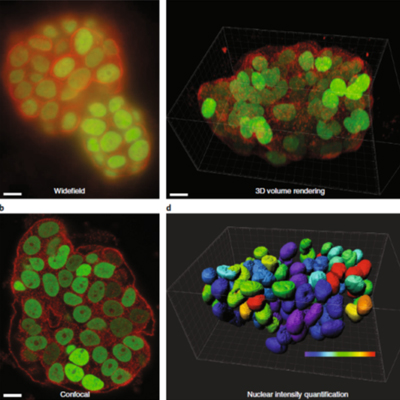
By switching the scanning module from a galvo-galvo to a resonant-galvo configuration, imaging speed was increased by approximately 40×. Notably, the signal level improvement from the images was nearly 2.8×, as seen in Fig. 1. The increase in signal attributed (compared to the galvo-galvo configuration) to reduced photobleaching due to shorter pixel dwell time. Additionally, higher spectral power was observed in images captured using Laser 2 compared to Laser 1. The improvement in signal level was consistently reproduced when the researchers repeated imaging of the same zebrafish.
Using fast resonant scanning, the study found that pulses with a sech² shape led to improved signal levels compared to Lorentzian-shaped pulses. This suggests that sech²-shaped pulses may offer better protection against photobleaching.

Figure 1. Zebrafish imaging in vivo with neurons tagged with gCAMP7f acquired with (a) Laser 1 and (b) Laser 2.
The full article can be accessed here.
1Singapore Centre for Environmental Life Sciences Engineering (SCELSE), Nanyang Technological University, Singapore. 2Lee Kong Chian School of Medicine, Nanyang Technological University, Singapore. 3School of Physical and Mathematical Sciences, Nanyang Technological University, Singapore. 4Institute for Digital Molecular Analytics and Science, Singapore.