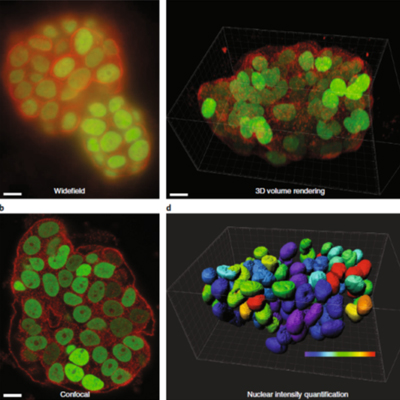
Using three-dimensional organotypic epidermal models, this study showed that treatment with para-hydroxycinnamic acid (pHCA) either before or after H2O2 challenge allowed the maintenance of high levels of lamin B1 (indicating the prevention of senescence). Furthermore, to assess the regenerative capacity of human primary keratinocytes (HPK), clonogenic assays were used. While H2O2 exposure led to a massive loss of HPK proliferative capacity, as revealed by the decreased colony number and size, both pHCA-treated and NAM-treated (niacinamide) populations showed an improved total clonogenic capacity by 2-fold.
Given that the inflammatory response is more pronounced after UV than H2O2 treatment in 3D full-thickness models, the study focused on testing inflammatory markers of UV-induced stress. Treatment with pHCA was found to significantly reduce the secreted levels of inflammatory biomarkers. Lastly, the study investigated the recovery of mitochondrial function after stress – with pHCA treatment, it was demonstrated that the basal respiration, maximal respiration, and ATP production had a significant increase, which signifies protected mitochondrial functions under stress conditions. Thus, all the results highlighted the protective effects of pHCA against inflammation and most importantly, the mechanism of action was elucidated.
The full article can be accessed here.
1A*STAR Skin Research Labs, Skin Research Institute of Singapore, Agency of Science, Technology and Research, Singapore. 2The Procter & Gamble Company, Mason, USA. 3Department of Biosciences, Durham University, UK. 4Procter & Gamble International Operations SA SG Branch, Singapore.