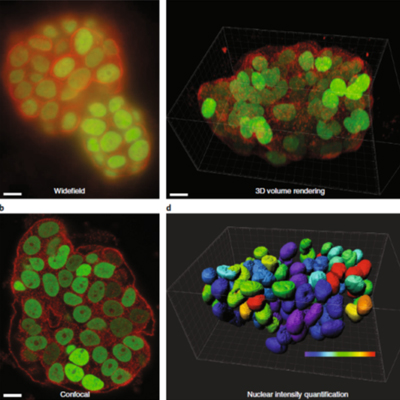
Multiphoton microscopy has emerged as a powerful modality for noninvasive, spatial, and temporal imaging of biological tissues without the use of labels and/or dyes. Providing complimentary imaging modalities, it includes two-photon excited fluorescence (2PEF) and second harmonic generation (SHG). 2PEF from endogenous chromophores such as nicotinamide adenine dinucleotides (NADH), flavins and keratin enable visualization of cellular and subcellular structures. SHG provides visualization of asymmetric macromolecular structures such as collagen. These modalities enable the visualization of biochemical and biological alterations within live tissues in their native state.
Organotypic cultures of the skin and oral mucosa equivalents have been increasingly used across basic and translational research. However, assessment of the skin and oral mucosa equivalents is predominantly based on histological techniques which are not suited for real-time imaging and longitudinal studies of the tissues in their native state. 2PEF from endogenous chromophores and SHG from collagen can be effectively used as an imaging tool for noninvasive and label-free acquisition of cellular and matrix structures of live skin and oral mucosa cultures.

Figure 1: Schematic of the optical layout of the multiphoton microscope

Figure 2: Annotated picture of the multiphoton microscope
This chapter shares the methods for noninvasive and label-free imaging of monolayer and organotypic cultures of the skin and oral mucosa using multiphoton microscopy. The technologies described in the chapter include imaging of the cells (keratinocytes and fibroblasts) using two-photon excited fluorescence (2PEF) and that of collagen secreted by the fibroblasts using second harmonic generation (SHG). The chapter demonstrates the methods for imaging monolayer and three-dimensional organotypic cultures of the skin and oral mucosa.
The full article can be accessed here.
1Faculty of Dentistry, National University of Singapore, Singapore, Singapore. dengs@nus.edu.sg. 2Institute of Medical Biology, A*STAR, Singapore, Singapore. 3Skin Research Institute of Singapore, A*STAR, Singapore, Singapore.