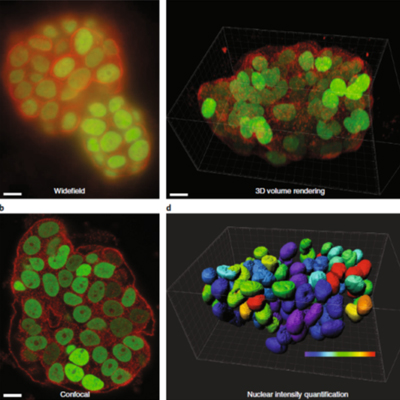
One factor behind the lack of reproducibility of experiments published in scientific journals is the frequent underreporting of imaging methods caused by a lack of awareness and/or a lack of knowledge of the applied technique. Although many calibration standards and protocols have been published, there is a lack of awareness and agreement on common standards and guidelines for quality assessment and reproducibility (Figure 1).
The QUality Assessment and REProducibility for Instruments and Images in Light Microscopy (QUAREP-LiMi) initiative was formed in April 2020 with an aim to address this. This initiative comprises imaging scientists from academia and industry who share a common interest in achieving a better understanding of the performance and limitations of microscopes and improved quality control (QC) in light microscopy.

Figure 1. Acquiring imaging data that is both quantifiable and reproducible involves a myriad of factors, few of which are acknowledged or accurately recorded. Intimate knowledge of the composition and performance of a system is essential for reproducibility. However, performance measurements may be tricky, and require specific protocols, tools, samples, training, and data analysis methods. In order to help microscope users to assess and judge the performance of their systems properly, the community must agree on and publish guidelines and benchmarks.
The goal of the QUAREP-LiMi initiative is to establish a set of common QC standards, guidelines, metadata models, and tools, including detailed protocols, with the ultimate aim of improving reproducible advances in scientific research. The QUAREP-LiMi initiative aims at convening the light microscopy community with the explicit purpose of reaching a broad consensus concerning Quality Control and Quality Assessment guidelines for optical microscopy to be adopted worldwide.
This White Paper is the first of a series that will report the ongoing progress towards achieving the stated goals of QUAREP-LiMi, and 1) summarizes the major obstacles identified in the field that motivated the launch of the QUAREP-LiMi initiative; 2) identifies the urgent need to address these obstacles in a grassroots manner, through a community of stakeholders including, researchers, imaging scientists, bioimage analysts, bioimage informatics developers, corporate partners, funding agencies, standards organizations, scientific publishers, and observers of such; 3) outlines the current actions of the QUAREPLiMi initiative, and 4) proposes future steps that can be taken to improve the dissemination and acceptance of the proposed guidelines to manage QC.
Proposed Community-Driven Approach
The QUAREP-LiMi community has grown significantly from inception (as at time of writing, 184 individuals from 20 countries). The initiative is designed to work in a completely transparent and open manner to foster ground-up participation from around the globe and ownership by all members of the community. Working groups were established to address various essential topics such as Illumination Power, Detection System Performance, Uniformity of Illumination Field-Flatness, Image Quality, System Chromatic Aberration and Co-Registration, Lateral & Axial Resolution, Stage & Focus, amongst some. When appropriate these working groups are expected to produce robust, easy-to-use protocol based upon standardized samples or tools.
Future Steps
The initiative will work towards a set of medium (few months) and long term goals (1-2 years). Medium-term goals include the growth and diversification of QUAREP-LiMi member body (to foster more engagement with industry, scientific publishers, funding agencies, and commercial microscope manufacturers), and the establishment of a consensus of accepted guidelines within the working groups. Long-term goals include the dissemination of new guidelines to the scientific community and its stakeholders, implementation of the new guidelines within the community, working with stakeholders to promote the implementation of new guidelines as well as modification of the existing ISO and establishing of new ISO standards based on guidelines developed by QUAREP-LiMi.
Conclusion
To summarize, the principal goal of the QUAREP-LiMi initiative is to improve the overall quality and reproducibility of light microscope image data by introducing broadly accepted standard practices and accurately captured image data metrics. The success of the QUAREP-LiMi initiative will depend on the amount of buy-in from all stakeholders.
The first step will be to reach a consensus between microscope and system component manufacturers, users, and microscope custodians regarding precisely what needs to be measured, how, and at what frequency, taking into account the experiment being performed and the downstream image analysis strategy. This should be followed by a set of common, practical tools to accomplish these measurements must be developed and provided to the entire community.
By providing a clear community-driven way forward and working closely with all stakeholders, QUAREP-LiMi has the potential to drive a culture change. This will benefit the entire community by fundamentally transforming image data quality and reproducibility.
The full article can be accessed here.
1Bioimaging Unit, Newcastle University, Newcastle upon Tyne, NE4 5PL, UK 2Janelia Research Campus, Howard Hughes Medical Institute, Ashburn, VA 20147, USA 3Visualisation, Irradiation & Analysis, Cancer Research UK Manchester Institute, Alderley Park, Macclesfield, UK 4National Institute of Standards and Technology, Gaithersburg, MD 20899, USA 5Euro-BioImaging, Heidelberg, 69117, Germany 6Advanced BioImaging Facility (ABIF), McGill University, Montreal, Quebec, H3G 0B1, Canada 7Unite Genetique et Biologie du Developpement U934, PICT-IBiSA, Institut Curie/Inserm/CNRS PSL Research University, Paris, 75005, France 8Department of Biochemistry, University of Oxford, Oxford, Oxon, OX1 3QU, UK 9Turku Bioscience Centre, Euro-Bioimaging ERIC, Turku, 20520, Finland 10Biocampus, CNRS UAR 3426, Montpellier 34293, France